Bonus: Comparing Total Cost of Ownership Across LLM Providers
Compare production agent TCO side-by-side across Google Gemini, OpenAI GPT, Anthropic Claude, and self-hosted Ollama.
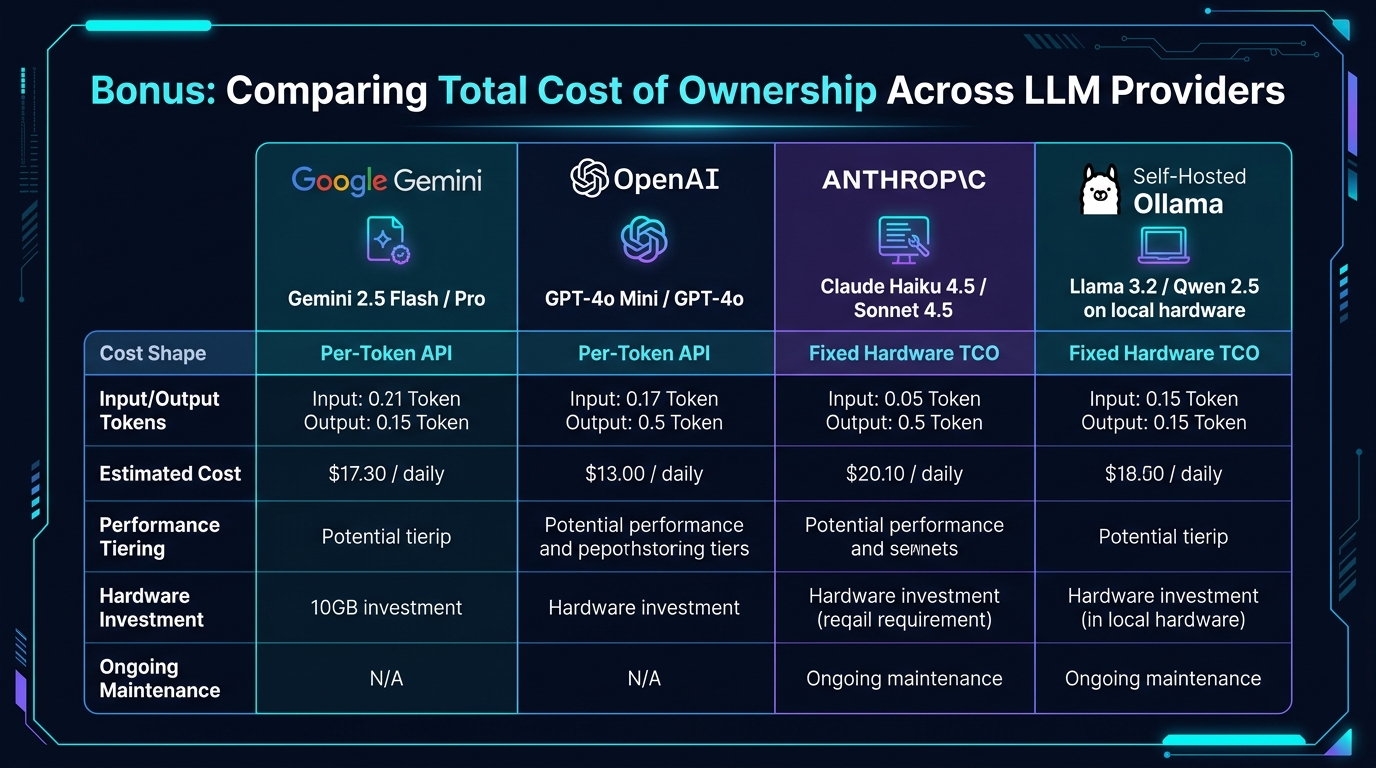
Bonus: Comparing Total Cost of Ownership Across LLM Providers
📦 Companion Code: View the complete, runnable code on GitHub:
part17in the cartpilot-adk2-series repository.
Part 15 made CartPilot's model provider swappable with one .env variable. Part 16 built a TCO calculator — for Gemini only. This part puts them together: the same TCO model, computed side-by-side across every provider Part 15 wired up, so "should we run this on Gemini, GPT, Claude, or a local Ollama model" becomes a number you compute instead of a guess based on one provider's list price.
What actually changes between providers, cost-wise
Only one thing: the per-token price. Everything else in Part 16's TCO model — hosting, third-party MCP tool costs, eval/CI runs, human-in-the-loop review time, observability storage — is a function of CartPilot's own architecture and traffic, not of which company's model answers a given call. That's the key simplification this script relies on: swap the pricing table, hold everything else constant, compare totals.
Extending the calculator
# provider_tco_compare.py
from dataclasses import dataclass

# Illustrative per-million-token pricing — verify current rates before
# using this for real budgeting.
PROVIDER_PRICING = {
    "google": {
        "default": {"input": 0.30, "output": 2.50},   # gemini-3.5-flash
        "strong":  {"input": 1.25, "output": 10.00},  # gemini-2.5-pro
    },
    "openai": {
        "default": {"input": 0.15, "output": 0.60},   # gpt-4o-mini
        "strong":  {"input": 2.50, "output": 10.00},  # gpt-4o
    },
    "anthropic": {
        "default": {"input": 0.80, "output": 4.00},   # claude-haiku-4-5
        "strong":  {"input": 3.00, "output": 15.00},  # claude-sonnet-4-5
    },
    "ollama": {
        "default": {"input": 0.0, "output": 0.0},     # local — no per-token cost
        "strong":  {"input": 0.0, "output": 0.0},
    },
}

# A local Ollama setup isn't free — it's a different cost SHAPE: fixed
# monthly hardware/power instead of per-token. Set to $0 if you're on
# hardware you'd own regardless; set it to a real number if this
# deployment is the reason you bought or rented that hardware.
LOCAL_HARDWARE_MONTHLY_USD = 400.0


@dataclass
class AgentProfile:
    """Provider-independent usage shape — how often and how much an
    agent talks has nothing to do with which provider answers."""
    name: str
    tier: str  # "default" or "strong"
    calls_per_conversation: float
    avg_input_tokens_per_call: int
    avg_output_tokens_per_call: int

    def cost_per_conversation(self, provider: str) -> float:
        prices = PROVIDER_PRICING[provider][self.tier]
        input_cost = (self.avg_input_tokens_per_call * self.calls_per_conversation
                       / 1_000_000 * prices["input"])
        output_cost = (self.avg_output_tokens_per_call * self.calls_per_conversation
                        / 1_000_000 * prices["output"])
        return input_cost + output_cost
The rest of the fixed-cost machinery (FixedCosts, compute_tco_for_provider) is Part 16's TCOAssumptions/compute_tco renamed and parameterized by provider — one meaningful addition:
def compute_tco_for_provider(provider, conversations_per_month, agents, fixed):
    llm_cost_monthly = sum(a.cost_per_conversation(provider) for a in agents) * conversations_per_month
    # ... mcp_cost_monthly, eval_cost_monthly, hitl_cost_monthly, log_cost_monthly
    # unchanged from Part 16 ...

    hosting_cost = fixed.hosting_monthly_usd
    if provider == "ollama":
        # Swap the cloud LLM API line for a local hardware line.
        hosting_cost += LOCAL_HARDWARE_MONTHLY_USD

    total = llm_cost_monthly + hosting_cost + mcp_cost_monthly + eval_cost_monthly + hitl_cost_monthly + log_cost_monthly
    return {"provider": provider, "llm_api_cost": round(llm_cost_monthly, 2),
            "hosting_cost": round(hosting_cost, 2), "total_monthly_usd": round(total, 2),
            "cost_per_conversation_usd": round(total / conversations_per_month, 4)}
That if provider == "ollama" branch is the whole point of modeling this honestly: a local model's token cost is genuinely $0, but treating that as "Ollama is free" is a mistake — the compute has to run somewhere, and that somewhere costs money (hardware, power, or a rented GPU instance) whether or not you're billed per token for it.
Running it against CartPilot's real shape
python provider_tco_compare.py=== CartPilot Monthly TCO by Provider (50,000 conversations/mo) ===
Provider LLM API Hosting Total/mo Per convo
--------------------------------------------------------------
google $ 280.95 $ 150.00 $ 654.95 $ 0.0131
openai $ 245.73 $ 150.00 $ 619.73 $ 0.0124
anthropic $ 583.40 $ 150.00 $ 957.40 $ 0.0191
ollama $ 0.00 $ 550.00 $ 774.00 $ 0.0155At this illustrative volume and with a $400/month hardware amortization assumption, Ollama is not the cheapest option — OpenAI and Gemini both undercut it, because 50,000 conversations/month isn't enough LLM-token spend to outweigh a fixed monthly hardware cost. That crossover point is exactly what this script is for: run it again at 500,000 conversations/month (just change conversations_per_month) and the ranking changes, because the fixed hardware cost gets amortized over far more usage while the cloud providers' bills scale linearly. There's a real break-even volume where local hosting starts winning — this script is how you find it for your own numbers instead of assuming "local is always cheaper" or "local is never worth it."
The caveat that matters most: cost isn't the only axis
The script prints this deliberately, and it's worth taking seriously rather than skimming past:
Only compare providers that clear the same bar on Part 12's eval suite. A cheaper provider that produces worse tool-call accuracy or worse structured-output reliability isn't actually cheaper once you account for the downstream cost — more refunds needing human review (Part 8), more support escalations, more shopper frustration. This script prices four cost centers explicitly; it does NOT automatically raise
refunds_needing_approval_per_monthoravg_approval_review_minuteswhen you swap in a weaker model, because it can't know that without you measuring it.
The correct workflow, combining everything this series has built:
- Run Part 12's eval suite against each candidate provider (swap
CARTPILOT_MODEL_PROVIDERfrom Part 15 between runs). - Only keep providers that pass your quality bar in the comparison at all — a provider that fails evals isn't a legitimate cheaper option, it's a different, worse product.
- For providers that do pass, feed this script your real usage numbers — token counts from Part 10's
usage_logrunning against each provider (token counts differ slightly by provider even for equivalent prompts, since tokenizers differ), not the illustrative defaults. - Also weigh latency and rate limits, which this script deliberately doesn't price — a provider that's technically cheaper per token but rate-limits you into dropped requests during a sale traffic spike has a cost this model can't capture in dollars.
Where this leaves the series
Part 15 gave CartPilot the ability to run on any model. Part 16 gave it a way to price itself as a whole system. This part closes the loop: the same portability that lets you swap providers for technical reasons (data residency, latency, a provider outage) also lets you swap them for economic reasons — and now you have a way to make that comparison honestly, hardware costs and quality bars included, instead of picking a provider once and never revisiting the decision as your usage volume changes.