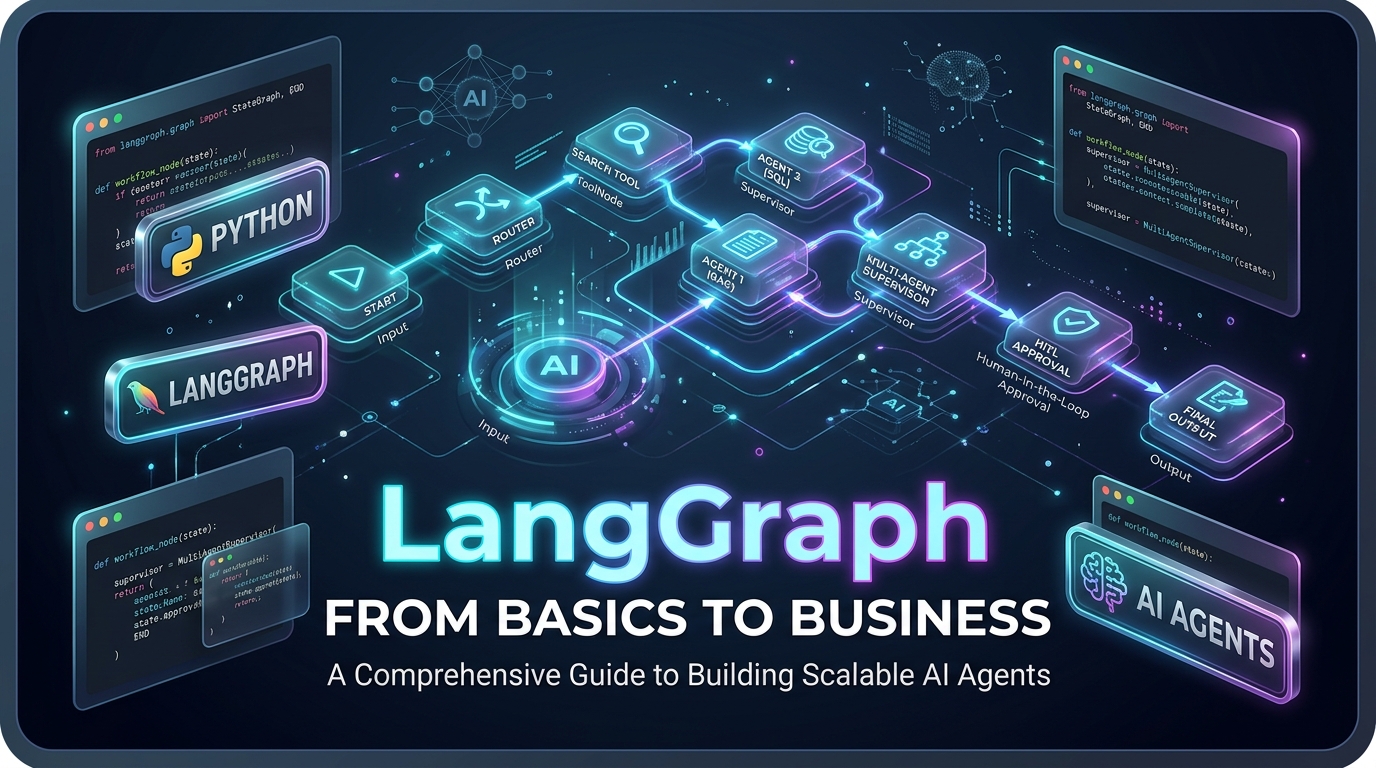
LangGraph: From Basics to Business
A 7-part developer's guide to LangGraph — from the core building blocks (State, Nodes, Edges, reducers) through tool-using agents, multi-agent architectures, human-in-the-loop patterns, and production persistence, finishing with a full business playbook covering operations, cost, hallucination mitigation, security, and a final decision framework for when LangGraph is — and isn't — the right choice.
Learning Path & Timeline
- Part 1•2026-08-21•Editorial
Why LangGraph Exists (And Why Not Something Simpler)
Every framework exists because something simpler broke down. Understand exactly which wall you hit that makes a graph-based approach worth the complexity — and when you don't need it at all.
- Part 2•2026-08-22•Editorial
LangGraph Core Building Blocks: State, Nodes, Edges, and Reducers
The four concepts that everything in LangGraph builds on — State, Nodes, Edges, and reducers — explained with code and the reasoning behind why each one is shaped the way it is.
- Part 3•2026-08-23•Editorial
Building Tool-Using Agents: The ReAct Loop, and Why It Beats a Hardcoded Sequence
Build a real tool-using agent with LangGraph's ReAct loop. Understand why loop-based control beats fixed sequences, how to cap iterations to prevent runaway costs, and how to handle tool failures gracefully.
- Part 4•2026-08-24•Editorial
LangGraph Advanced Patterns: Multi-Agent Systems, Human-in-the-Loop, and Persistence
Parts 1–3 covered LangGraph fundamentals and a working tool-using agent. This post covers multi-agent architectures (supervisor, swarm, hierarchical), human approval with interrupt(), and production-grade persistence.
- Part 5•2026-08-25•Editorial
Real-World LangGraph: A Production Customer Support Triage Agent
Assembles everything from Parts 1–4 into one realistic system — a customer support triage agent with intent classification, human review gates, and SQLite persistence — explaining the reasoning behind every architectural decision.
- Part 6•2026-08-26•Editorial
LangGraph Business Playbook I: Operations and Cost
Parts 1–5 were about building the thing. This post covers the two questions that come up in every budget and roadmap conversation: operations (observability, deployment model, paused runs, iteration caps) and cost (per-node cost modeling, model tiering, caching, human-review staffing).
- Part 7•2026-08-27•Editorial
LangGraph Business Playbook II: Maintainability, Hallucination, Security, and the Final Decision Framework
Closing out the series: the three concerns that determine whether a LangGraph system survives past its first six months — maintainability, hallucination mitigation, and security — plus a decision framework for when to use LangGraph at all.